Showing posts with label Taxation Policies. Show all posts

Pre-requisite of Taxes in India
The Act includes perquisites in the inclusive definition of salary by virtue of Sec 17(1). Thus perquisites are taxable as income under the head ‘Salary’. Sec 17(2) lists certain items which are to be treated as perquisites, for example, accommodation free of rent or at concessional rental charges, stock options, life insurance premium, etc.
Sec 17(2) also specifies certain medical benefits which are not to be included as perquisites.The rules for valuation of the following perquisites are given in Rule 3 of the Income Tax Rules:
  • rent free accomodation
  • any concession in the matter of rent respecting any accomodation
  • any benefit or amenity granted or provided free of cost or at concessional rate to ‘specified employees’ only.

These items are non-monetary and hence the need for laying down valuation rules.

What is Fair Rent?
Fair Rent is the municipal valuation of the accommodation, or rent which a similar accommodation would realize in the same locality, whichever is higher. However, it cannot exceed the standard rent, if any, fixed or determine under a Rent Control Act. If the employer hires the accommodation, Fair Rent Value is the actual rent paid for the accommodation


What is Municipal Valuation of Fair Rent?
House tax is collected by municipality on the basis of its rental value, ie the municipality decides what will be the rental value if the house is given on rent. Such rental value is called Municipal Valuation of Fair Rent.


What is Standard Rent?
Under the Rent Control Act, Standard Rent is the highest possible rent of a particular property,
Thus, where Rent Control Act is applicable, Standard Rent shall act as an upper ceiling on the figure of Fair Rent.


How is Salary determined for the purpose of Valuation of Rent Free Accommodation?
For the purpose of Valuation of Rent Free Accommodation, salary is determined on the following basis:
1) Salary is taken on due basis only.
2) The following are the components of salary : Basic Pay, Dearness Allowance/ Dearness Pay (if it forms part of salary for the purpose of retirement benefits, ie gratuity, pension, PF and leave salary), bonus, commission, fees, etc., taxable portion of all allowances, reimbursement of income tax and professional tax, reimbursement of gas, electricity and water expenses, any other payment.
3) The following items are excluded from the computation of salary: value of all perquisites, employer’s contribution to PF and interest thereon.

What if the employer takes a house on rent for the employee?
While computing the value of fair rent, whether defacto rent (the rent paid by the employer) is to be considered or not, is controversial.
a) One view is that defacto rent should be ignored as the Income Tax Rule on valuation of rent free accomodation is silent about it.
b) The second view equates defacto rent to fair rent.
c) The third view takes defacto rent into consideration for calculating fair rent. As per this view, if defacto rent exceeds the fair rent calculated otherwise (i.e, upto the step in which Standard Rent is considered), then defacto rent shall be taken to be the Fair Rent.

What if the Rent Free Accommodation is a furnished one?
In this case, first the value of rent free accomodation is calculated assuming it is not furnished. If the furnishing is owned by the employer, 10% of the original cost of furnishing is added; and if the furnishing is taken on hire, the actual hire charges are added.


What are the valuation rules for Accommodation provided at concessional rates?
First, the perquisite value is calculated assuming the accomodation is provided rent free. From this value, the rent for the period of occupation payable by the employee to the employer is deducted. This gives the perquisite value for accomodation provided at concessional rates.

What are the valuation rules for Rent Free Accomodation?


Is the Motor Car facility treated as a perquisite for all types of employees?
No, a motor car provided to employees shall be treated as a perquisite only in the case of ‘specified employees’. However, if the car is owned by the employee and the employer merely bears the expenses on the car, then the perquisite value shall be computed even if the employee is not a specified employee.


Who is a ‘specified employee’?
A ‘Specified employee’ is the one who satisfies any of the following cases:

  • he is a director of the company,
  • he has a substantial interest in the company, ie he is the beneficial owner of equity shares carrying 20% of voting power in the employer company.
  • his monetary income under the head "Salaries" for the year exceeds Rs.24,000. The amount considered here includes amounts due from, paid or allowed by one or more employers. It excludes all non-monetary benefits.
  • Also, deductions in respect of monetary payments exempt from income tax, standard deduction, deduction for educational allowance and deduction on account of professional tax will be allowed for this purpose.
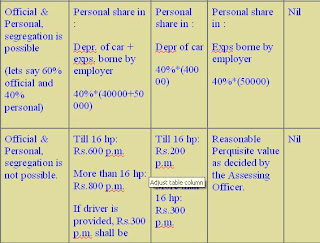
How is the value of Motor Car facility computed? The following table gives the perquisite value of the motor car facility under different situations, taking the written down value of the car at the beginning of the year as Rs.2,00,000, depreciation u/s 32 of the Income Tax Act at 20%, ie Rs.40000 and expenses on the car during the year Rs.50,000.


What happens in case the employer maintains a pool of cars?
If the employer has provided a number of cars of different horse powers to a number of employees, for personal as well as official uses, it will be presumed that every employee was using the car with the highest horsepower rating and the perquisite value will be computed accordingly.
Similarly, if there are some cars without driver and some with driver, it will be presumed that every employee was using the car with driver.


What if the employee pays certain amount for using the car?
If the employee is paying a certain amount for using the car, such payment shall be deducted from the perquisite value.

What if the employee uses the official car only to commute between office and residence?
Such use shall be treated as official use and hence there is no perquisite.

Is the gas / electricity / water facility a perquisite for all employees?
If the facility for gas/ electricity/ water is provided by the employer, then the perquisite value shall be computed only in the hands of specified employees.
If the connection is in the name of the employee and the employer merely bears the expenses, perquisite value shall be computed even if the employee is not a specified employee.

How is the perquisite value computed for gas/ electricity/ water facility provided by the employer?

  • If the facility is provided by the employer, it shall be a perquisite only in the hands of specified employees.
  • If the employer supplies these from his own sources, PV = Nil
  • If the facility is purchased by the employer and the employee uses it only for personal purposes, PV = the amount spent by the employer.
  • If the facility is purchased by the employer and is used by the employee for both official and personal purposes, then PV is taken as 6.25% of salary but shall not exceed the amount actually spent by the employer.

Salary for this purpose shall be:

  • Basic pay on due basis
  • Dearness Allowance or dearness pay, if the terms of employment so provide Commission, if it is on sales turnover, calculated at a fixed rate and the employee works in the sales department.

What if the gas/ electricity/ water connection is in the name of the employee and the employer bears the expenses?
This is a case of reimbursement of employee’s expenses. All employees shall be covered, whether or not they are specified employees. The entire amount borne by the employer shall be taken to be the perquisite value.


What are the rules for computing perquisite value of Free Education provided by the employer?

  • Free Education provided by the employer is a perquisite only for specified employees.
  • If the employer provides free education to employee, PV = Nil.
  • If the employer provides free education to the family members of the employee, PV = actual amount spent by the employer.
  • If free education is provided in an institution run by the employer himself, PV = cost of education in a similar institution in the same locality
  • If any scholarship is given to the family members of the employee purely on the basis of merit, PV = nil.

What if the employee’s costs on education are borne by the employer?
The entire amount borne by the employer shall be the perquisite value. This shall be applicable in the cases of all employees, not just the specified employees.


What are the valuation rules for transport facility provided by a transport undertaking free of cost or at concessional rates?
Nil. Various organizations running transport services provide free or concessional travel to their employees/ their family members/ dependent relatives in conveyance owned by the undertaking. The perquisite value of such benefit shall be taken to be nil.


How to value a perquisite for which no specific rules are given in Rule 3 of the Income Tax Rules?
The valuation will be done in a way the Assessing Officer considers fair and reasonable.

How is the perquisite value determined in case a watchman / sweeper / gardener / other domestic servant is hired by the employee and the expense is borne by the employer?
The actual expense borne by the employer shall be taken to be the perquisite value. This shall apply to all categories of employees, not just the specified employees.

What if the servant is hired by the employer and his services provided to the employee?
In this case, perquisite shall be only in the hands of specified employees. The Perquisite Value in the case of watchman, sweeper and gardener shall be Rs.120 per month per person. For other domestic servant, the PV shall be actual wages paid by the employer.

Stumble Upon Toolbar

Tax upon profits in lieu of or in addition to salary
The amount of any compensation due to or received by an assessee from his employer or former employer at or in connection with the termination of his employment or the modification of the terms and conditions relating thereto;

Any payment (other than any payment referred to in clause (10) clause (10A)clause (10B, clause (11), clause (12), clause (13) or clause (13A) of section 10), due to or received by an assessee from an employer or a former employer or from a provident or other fund, to the extent to which it does not consist of contributions by the assessee or interest on such contributions or any sum, received under a Keyman insurance policy, including the sum allocated by way of bonus on such policy. The expression "Keyman Insurance policy" shall have the meaning assigned to it in clause (10D) of section 10;
Any amount, due to or received, whether in lump sum or otherwise, by any assessee from any person in the following cases:
  • Before his joining any employment with that person; or
  • After cessation of his employment with that person.

Stumble Upon Toolbar

Annuity Tax

Annuity Tax
Employee often gets annual grant from his employer. Such grant is called as annuity. Annuity falls under the category of salary. The employer may pay the annuity either voluntarily or on account of contractual agreement. A deferred annuity is not taxable until the right to receive the same arises. Other form for annuities made under a will or granted by a life insurance company or accruing as a result of contract come under the head "Income from Other Sources" and are assessed u/s 56 of the I.T. Act.

Stumble Upon Toolbar

Tax on Annuity

Tax on Annuity
Employee often gets annual grant from his employer. Such grant is called as annuity. Annuity falls under the category of salary. The employer may pay the annuity either voluntarily or on account of contractual agreement. A deferred annuity is not taxable until the right to receive the same arises. Other form for annuities made under a will or granted by a life insurance company or accruing as a result of contract come under the head "Income from Other Sources" and are assessed u/s 56 of the I.T. Act.

Stumble Upon Toolbar

Gratuity Tax

Gratuity Tax
Gratuity is an amount that is received by an employee at the time of his retirement or by his legal heir in the event of death of the employee. Gratuity is considered as an income and the employee who received gratuity is liable to pay the tax on the same. Gratuity is taxable under the head "Salary" and gratuity received by the legal heir is taxable under the head" Income from Other Sources".

In both the above situations gratuity upto a specified limit is exempt under the provisions of sec.10(10) of the Income Tax Act, 1961.

For the purpose of exemption of gratuity under sec.10(10) the employees are divided under three categories:

Govt. employees
The entire amount of death-cum-retirement gratuity of the govt. employees is exempted from tax and nothing is therefore taxable under the head Salaries.

Employees covered under the Payment of Gratuity Act, 1972
The employees covered under the Gratuity Act who receive gratuity have been given exemption which is the minimum of the following amounts. Gratuity received in excess of the minimum of the amounts mentioned below is included in the gross salary for the purposes of taxation.
  • The amount of gratuity actually received.
  • Fifteen days' salary (7 days in the case of seasonal employment) for every completed year of service provided the employment is more than six months.
Other employees
In the case of other employees the gratuity received or receivable on his retirement or on his becoming incapacited prior to such retirement or termination of his employment or any gratuity received by his heirs is exempt to the extent of the minimum of the following amounts. The amount received in excess of the sums mentioned below is included in the gross salary of the employee for the purposes of taxation.
  • Actual amount of gratuity received.
  • Half month's average salary for every completed year of service. (Average salary means the average of the salary drawn by the employee for 10 months immediately preceding the month in which he retires)

Stumble Upon Toolbar

Bonus
Bonus is taxable on receipt basis and is included in the gross salary in the year in which the bonus is received.

Fees & Commissions
Any fees or commission received by the employee or receivable by the employee is fully taxable and has to be included in gross salary. Commission may be a fixed amount per annum or may be a percentage of turnover or net profit. However, the same is taxable under the head "Salaries" when it is received or receivable by the employee.

Stumble Upon Toolbar

Pension Tax in India


Pension Tax in India
According to pension act pension is defined as a periodical allowance or stipend granted on account of past service, particular merits etc. The three main components of pension are:

  • Pension is a compensation for past service
  • It owes its origin to a past employer-employee or master-servant relationship
  • It is paid on the basis of an earlier relationship of an agreement of service as opposed to an agreement for service. This relationship terminates only on the death of the concerned employee.

Pension received from a former employer is taxable as 'Salary'. Hence, the various deductions available from salary income, including relief u/s 89(1) for the arrears of pension received would be granted to pensioners who receive their pension from, a nationalized bank, by the bank and in other cases their present Drawing & Disbursing Offices. Similarly, deductions from the amount of pension of standard deduction and adjustment of tax rebate u/s 88 and 88B shall be done by the concerned bank, at the time of deduction of tax at source from the pension, on furnishing of relevant details by the pensioner.

Pension to officials of UNO is exempt from taxation.

Family Pension
Under family pension a regular monthly amount is paid by the employer to a person belonging to the family of an employee in the event of death. Pension and family pension are qualitatively different. The former is paid during the lifetime of the employee while the latter is paid after his death to surviving family members. However, in case of family pension, since there is no employer-employee relationship between the payer and the payee, therefore, it is taxed as ' Income from Other Sources' in the hands of the nominee(s). In respect of family pension,deduction u/s 57(iia) of Rs. 15000 or 1/3rd of the amount received whichever is less, is available.

Senior Citizen

Under the Income Tax Act, a senior citizen is a person who at any time during the previous year has attained the age of 65 years or more. There are certain benefits available to senior citizen under the Income Tax Act:-
Tax rebate u/s 88B: Upto assessment year 1997-98, rebate on tax payable by a senior citizen was allowable provided the income was below a certain limit(for assessment year 1996-97,98-99,40% tax rebate was available to a senior citizen provided his income was below Rs. 1.2 Lakhs).Form assessment year 1998-99, the tax rebate is available to all senior citizen to the extent of the entire tax payable or Rs. 10000 whichever is less without any ceiling on the income. This rebate has been further enhanced to Rs. 15,000 from A.Y. 2001-2002 onwards. Rebate under this section has now been increased to Rs.20,000/- form A.Y. 2004-05 by the Finance Act 2003. This rebate is available to all senior citizens whether they are pensioners or self employed or traders etc.

The 1 out of 6 criteria for filing of income tax return under proviso to Sec. 139(1) shall not be applicable in case of senior citizen. However, if a senior citizen meets any of the four criteria, other then ownership of immovable property of subscription to a telephone, then return will have to be filed by him.

Other Benefits: The deduction available u/s 80D for medical insurance premium paid is to be increased to Rs. 15,000 for senior citizens. Secondly , the deduction available u/s 80DDB in respect of expenditure incurred on treatment of specified diseases is tobe increased to Rs. 60,000 for senior citizens. The above provisions shall come into effect from assessment year 2000-2001 onwards.

Stumble Upon Toolbar

Tax upon salaries and wages
Income Tax on Salary
Salary includes the pay, allowances, bonus or commission payable monthly or otherwise or any monetary payment, in whatever name called from one or more employers, as the case may be, but does not include the following, namely:
  • dearness allowance or dearness pay unless it enters into the computation of superannuation or
  • retirement benefits of the employee concerned;
  • employer's contribution to the provident fund account of the employee;
  • allowances which are exempted from payment of tax;
  • the value of perquisites specified in sub-section (2) of section 17 of the Income-tax Act;

Salary also includes the following:

  • Wages;
  • Any annuity or pension;
  • Any gratuity;
  • Any fees, commissions, perquisites or profits in lieu of or in addition to any salary or wages;
  • Any advance of salary;
  • Any payment received by an employee in respect of any period of leave not availed of by him;
  • The annual accredition to the balance at the credit of an employee participating in a recognized provident fund, to the extent to which it is chargeable to tax under Rule 6 of Part A of the Fourth Schedule; and
  • The aggregate of all sums that are comprised in the transferred balance as referred to in sub-rule (2) of rule 11 of part A of the Fourth Schedule of an employee participating in a recognized provident fund, to the extent to which it is chargeable to tax under sub-rule (4) thereof.
Salary also includes:
Perquisites: include all benefits provided by an employer to the employee like company leased accommodation, car, free education, etc. This represents provision of a facility rather than an allowance for expense. These components are offered to tax based on the value prescribed as per the perquisite valuation rules.

Profit in lieu of salary: includes non-recurring, one-off payments received by the employee e.g. joining bonus, compensation for termination of employment or modification in the terms of employment etc.

Stumble Upon Toolbar

Taxable Head of Income

Taxable Head of Income
For the purpose of computation and charge of income tax, all incomes are classified into following heads:
Others:
  • Tax upon Allowances
  • Tax upon Deferred compensation
  • Tax equalization

Besides remuneration for work, individuals may be taxed on the following income:

  • Tax upon Income from house property
  • Tax upon Income from business or professions
  • Tax upon Income from capital gains
  • Tax upon Income from other sources
  • Tax upon Clubbing of Income
  • Avoidation of double taxation
  • Filing of Return - compulsory

Stumble Upon Toolbar

Understanding Income Tax in India
Before moving ahead lets have a quick understanding of Income tax system in India. For the purpose of tax :
  • It is on the total income of the assessee, Income tax is levied
  • The previous year income is taxed in the 'assessment year.'
  • For the purpose of Tax income is classified and computed under five categories called 'heads of income.
  • The basic principle of income tax is 'pay as you earn.'
  • One must pay his taxes in advance and by the due dates, in the prescribed percentages.
  • Deferment in the payment of advance tax would result in the payment of interest.
  • The definition of salary, wages, pension, allowance, etc. is provided in the “Taxable Heads of Income”

Pay as you Earn
Under this principle, the tax payer is saved from lump sum payment of the tax at the end of the year
Such payments are done during the previous year in the form of 'TDS', 'TCS' and 'advance tax.'Thus
a person is not allowed to wait until 31 March to pay his/her taxes.


TDS (Tax deducted at source)
When the tax is deducted at the source of the income the employer or the payer and paid to the government, it is called as TDS. This incorporates salary, interest, commission and contract fees, rent, professional fees, etc. Such tax is subject to certain limits and certain conditions. For example if the earning up on fixed deposit is Rs. 5,000 in a bank, TDS at 10% and education cess at 2% i.e. a total of 10.2% will be deducted at the time of credit or at the time of payment, whichever is earlier.

In case of senior citizen, if he/she estimates that the tax on the income is nil, Form No.15H duly filled and signed is to be submitted in duplicate to the bank. So, no TDS will be deducted. If the total income is less than the threshold limit, Form No.15G is to be submitted to the payer to prevent TDS from such interest.

TCS (Tax collected at source)
TCS is a collection of a tax by a seller of certain specified goods at the specified rates on the purchase of the goods and it is remitted to the treasury on behalf of the buyer. Similarly, a person granting a lease or licence in a parking lot, toll-plaza, etc. collects the taxes at the specified rates as tax paid on behalf of the lessee.

Advance Tax
Advance Tax is paid by the tax payer, during the previous year. The computing of the liability of advance tax is done by estimating the 'total income' for the year, calculating the surcharge and taking into consideration the rebate that will be available. The advance tax is required to be paid in three instalments.


If the assessee does not pays the advance tax as described above, an interest of 1% is charged per month for 3 months for the deferment of advance tax installment. If the total amount of advance tax is not paid on or before 15 March, an interest of 1% is charged for one month.

Further, if the total advance tax paid is less than 90% of the advance tax payable, the interest at 1% per month is charged for the shortfall in the advance tax paid for the period commencing from 1 April of the assessment year and ending on the date of payment or assessment, whichever is earlier.

Stumble Upon Toolbar

Income Tax
Income Tax is all income other than agricultural income levied and collected by the central government and shared with the states. As per Income Tax Act 1961, every person, whose net income exceeds the exemption limit comes under the tax net and he shall be charged tax at the rate or rates prescribed in the finance act. Such income tax shall be paid on the total income of the previous year in the relevant assessment year. The total income of an individual is determined on the basis of his residential status in India.

There are two types of taxes in India- Direct Tax and Indirect Tax.
  • In direct tax, burden falls directly on the taxpayer. Example of direct taxes are: income tax, wealth tax, etc. are those whose
  • In indirect taxes the burden can be transferred to the third party. Examples of Indirect taxes are:
    service tax, VAT, etc. can be passed on to a third party.
Residence Rules
An individual is treated as resident in a year if present in India
for 182 days during the year or

for 60 days during the year and 365 days during the preceding four years.

Individuals fulfilling neither of these conditions are nonresidents. (The rules are slightly more liberal for Indian citizens residing abroad or leaving India for employment abroad.)


A resident who was not present in India for 730 days during the preceding seven years or who was nonresident in nine out of ten preceding years is treated as not ordinarily resident. In effect, a newcomer to India remains not ordinarily resident.

For the purpose of tax, an individual may be resident, nonresident or not ordinarily resident.

Non-Residents and Non-Resident Indians

  • Residents are charged tax on worldwide income. Whereas Nonresidents are taxed only on income that is received in India or arises or is deemed to arise in India. A person not ordinarily resident is taxed like a nonresident but is also liable to tax on income accruing abroad if it is from a business controlled in or a profession set up in India.

  • Capital gains on transfer of assets acquired in foreign exchange is not taxable in certain cases.

  • Non-resident Indians are not required to file a tax return if their income consists of only interest and dividends, provided taxes due on such income are deducted at source.

  • It is possible for non-resident Indians to avail of these special provisions even after becoming residents by following certain procedures laid down by the Income Tax act.

Taxability of an Individual

Stumble Upon Toolbar

Tax Information Network (TIN)
Black money has always been the problem for the government. Indian tax depart from time to time comes with a unique method and system to unearth this black money. Some of the measures taken by the Income tax department in the past include- Tax on cash withdrawals and the annual information returns (AIR). Latest in this is TIN - Tax Information Network which was announced in the Union Budget 2003-04.

Features of TIN
TIN has certain features which every tax payer should know
  • Now the whole banking system will be linked to the TIN central system.
  • The banks will provide all online accounting information on tax paid by various entities to the TIN central system.
  • TIN also provides direct uploading by deductors through a web interface.
  • TIN design provides TIN Facilitation Centers for different entities having different computer skills.
Objectives of TIN
  • The demat of TDS/TCS certificates will help the assessee to file the paperless IT returns .
  • TDS fraud can be eliminated through the cross verification of the TDS and the TCS by the various organizations (deductors) with the credit claimed by the respective assessees..
  • Government and corporate employer organizations can file TDS returns through electronic medium. This e-filing will eliminate the need to enclose copies of challans and other documents and thus lead to a marked reduction in the cost of tax compliance.
  • AIR computerization on high value transactions will result in eventual widening and deepening of the country's tax base.
Benefits to the Government from TIN
  • TIN will monitor the Tax deduction at source (TDS) and advance tax payments
  • On the basis of permanent account number (PAN), TIN will process data on tax payers filing returns
  • Amendments to the Prevention of Money Laundering Act and the setting up of Financial Intelligence
  • Tax offenders can be tracked down easily
  • Collection will be boosted by strong Investigation and audit.
TIN Facilitation Centers
  • TIN Facilitation Centers has been set up by National Security Depository Ltd. (NSDL) for receiving, digitization and upload of e-TDS returns, TAN & PAN Applications to the TIN central system.
  • As per the specifications of the Income Tax Department (ITD), TIN Facilitation Centers are setup at 252 locations across the country to facilitate deductors furnish their e-TDS returns.

Activities carried out by TIN Facilitation Centers

  • Obtain e-TDS returns from deductors and upload them to the central TIN central system.
  • Receive Form 49B (application for issuance of TAN ) from deductors.
  • Get Form 49A (application for issuance of PAN ) from applicants.
  • Receive Request for New PAN card and / or Changes or Correction in PAN data from applicants.

Stumble Upon Toolbar

Income Tax Payment

Income Tax Payment
The list of forms of certificates to be issued and necessary form filled with assessing officer by the person deducting the tax at source :-


Click For Larger Image


Deduction of Tax At Source

Person paying the tax on salaried income is required to compute the tax liability in respect of such income and deduct tax at source at the time of payment. If the employee has any other income he can inform the employer in which case the employer can take that income into consideration for computing his tax liability. He will not take account of loss except loss from house property.

Those responsible for paying any income by way of interest on securities or any other interest are required to deduct tax at source at the prescribed rates at the time of credit of such income to the account of the payee or at the time of payment thereof by any mode. W.e.f. 01.07.1995 interest on term deposits with banks is also subject to such deduction.

Tax Collection at Source

In some cases, sellers collect the tax from the buyers at source at the point of sale. Such tax collection is to be made by the seller at the time of debiting the amount payable if the buyer to the account of the buyer or at the time of receipt such amount from the said buyer, whichever is earlier.

Advance Tax

Tax payers whose total income is likely to be chargeable to tax for the assessment year are required to pay tax in advance during the financial year (April 1 to March 31) on their estimated current income, which will be assessable to tax during the next following financial year called assessment year. The current income for this purpose means the total income which will be chargeable to tax in the relevant assessment year.

The advance tax payable is the tax on the current income minus the tax deductible at source or collectible out of any income included in the current income.

If the tax payer does not make payment of advance tax voluntarily, the assessing officer can issue a notice at any time during the financial year, but not later than the last day of February asking him to pay the advance tax in specified instalments. Such notice is ordinarily based on the assessed income of the tax payer for the latest year.

The assessee in that case has an option to pay advance tax on the basis of his own estimate if he considers that his current income during the relevant accounting period would be less than the income on the basis of which advance tax has been demanded from him. The assessing officer can modify his notice of demand in certain circumstances. Similarly, the assessee can also revise his estimate any number of times and after adjusting the amount already paid, if any, pay the balance in instalments falling due after the revised estimate.

Consequence of Default of Delay

If there is a delay in furnishing the return, it can attract charge of interest for every month or part of a month for the period of delay on the amount of tax found due on the proceesing of return or on regular assessment (refer para 13.6) after giving credit for advance tax and tax deducted at source. In case of failure to file the return such interest is to be calculated up to the date of best judgment assessment under sec.144.
A person liable to tax is required to file a return of income with the Assessing Officer having jurisdiction over his case. The return forms for the purpose can be obtained from any Income Tax Office or from a specified Post Office. The assessee before filing the return is expected to compute the tax on his returned income by way of self-assessment and if there is any additional liability of tax, the assessee is required to pay the same. The unpaid tax if any is recovered according to the procedure specified in the Act.

For the convenience of non-residents liable to Indian Income Tax, Non -residents Circles have been created in big cities namely, Bombay, Delhi, Calcutta, Madras, Cochin and Ahmadabad. Any person who is a non-resident and has not yet been assessed to tax any where in India, may file his income tax return in any of the above mentioned Non-resident Circles. However, once he files return in any of these Circles, Jurisdiction over his case will continue to be with circle unless it is change under orders of the appropriate authority.

Stumble Upon Toolbar

Acts Related To Foreign Investment
Foreign investments are subjected to certain guidelines. Government of India has come out with various acts that give clear guidelines to the foreign investors as to how to move towards investment. Foreign investors need to know these acts which would help them in their investment process.

Foreign Exchange Management Act, 1999 (FEMA)
Under FEMA provides full convertibility on capital and current account transactions for non-residents is allowed. However under this act, residents are subjected to non-convertibility on capital account transactions only. FEMA, treats an Indian company with foreign equity participation at par with other locally incorporated companies. The exchange control laws and regulations are applicable both for residents and the foreign-invested companies as well.

Repatriation
Repatriation of capital
Foreign capital that is invested in India can be repatriated along with capital appreciation, if any, after the payment of taxes due on them, provided the investment was approved on a repatriation basis.

Repatriation of dividends and profits
Profits and dividends earned through foreign investment in India can be repatriated after the payment of taxes due on them. In this case permission of RBI is not required for effecting remittance; however this is subject to compliance with certain specified conditions.

Acquisition of Immovable property
Acquisition of immovable property by a Non-resident

A person who is residing outside India, who has received permission from RBI to establish a branch, or office, or place of business in India (excluding a Liaison Office), has general permission of RBI to acquire immovable property in India, that is necessary for, or incidental to, the activity. However, in such cases, it is necessary to file a declaration, in prescribed form (IPI), with RBI, within 90 days of the acquisition of immovable property.

Foreign nationals of non-Indian origin acquiring immovable property in India with the specific approval of RBI can only transfer such property with prior permission from the RBI.
Acquisition of immovable property by NRI

An Indian citizen residing outside India (NRI) can acquire immovable property, other than agricultural/plantation/farm house in India by way of purchase. All the immovable properties except the agricultural or plantation property or farm house can be transferred to a person resident outside India who is a citizen of India or to a person of Indian origin resident outside India or a person resident in India.

Stumble Upon Toolbar

Time limit for completion of assessments
(1) Section 143 or section 144 says that no order of assessment shall be made at any time after the expiry of-

(a) two years from the end of the assessment year in which the income was first assessable; or

(b) one year from the end of the financial year in which a return or a revised return relating to the assessment year commencing on the 1st day of April, 1988, or any earlier assessment year, is filed under sub-section (4) or sub-section (5) of section 139, whichever is later.

(2) No order of assessment reassessment or recomputation shall be made under section 147 after the expiry of one year from the end of the financial year in which the notice under section 148 was served:
Provided that where the notice under section 148 was served on or before the 31st day of March, 1987, such assessment, reassessment or recomputation may be made at any time up to the 31st day of March, 1990.

(2A) Notwithstanding anything contained in sub-sections (1) and (2), in relation to the assessment year commencing on the 1st day of April, 1971, and any subsequent assessment year, an order of fresh assessment in pursuance of an order under section 250, section 254, section 263 or section 264, setting aside or cancelling an assessment, may be made at any time before the expiry of one year from the end of the financial year in which the order under section 250 or section 254 is received by the Chief Commissioner or Commissioner or, as the case may be, the order under section 263 or section 264 is passed by the Chief Commissioner or Commissioner:

Provided that where the order under section 250 or section 254 is received by the Chief Commissioner or Commissioner or, as the case may be, the order under section 263 or section 264 is passed by the Chief Commissioner or Commissioner, on or after the 1st day of April, 1999 but before the 1st day of April, 2000, such an order of fresh assessment may be made at any time up to the 31st day of March, 2002.

(3) The provisions of sub-sections (1) and (2) shall not apply to the following classes of assessments, reassessments and recomputations which may, be completed at any time-

(ii) where the assessment, reassessment or recomputation is made on the assessee or any person in consequence of or to give effect to any finding or direction contained in an order under section 250, section 254, section 260, section 262, section 263, or section 264 or in an order of any court in a proceeding otherwise than by way of appeal or reference under this Act;

(iii) where, in the case of a firm, an assessment is made on a partner of the firm in consequence of an assessment made on the firm under section 147.

Explanation 1.-In computing the period of limitation for the purposes of this section-

(i) the time taken in reopening the whole or any part of the proceeding or in giving an opportunity to the assessee to be re-heard under the proviso to section 129, or

(ii) the period during which the assessment proceeding is stayed by an order or injunction of any court, or
The following clause (iia) shall be inserted after clause (ii) in Explanation 1 to sub-section (3) of section 153 by the Finance Act, 2002, w.e.f. 1-4-2003:

(iia) the period commencing from the date on which the Assessing Officer intimates the Central Government or the prescribed authority, the contravention of the provisions of clause (21) or clause (22B) or clause (23A) or clause (23B) or sub-clause (iv) or sub-clause (v) or sub-clause (vi) or sub-clause (via) of clause (23C) of section 10, under clause (i) of the proviso to sub-section (3) of section 143 and ending with the date on which the copy of the order withdrawing the approval or rescinding the notification, as the case may be, under those clauses is received by the Assessing Officer;

(iii) the period commencing from the date on which the Assessing Officer directs the assessee to get his accounts audited under sub-section (2A) of section 142 and ending with the the last date on which the assessee is required to furnish a report of such audit under that sub-section, or

(iva) the period (not exceeding sixty days) commencing from the date on which the Assessing Officer received the declaration under sub-section (1) of section 158A and ending with the date on which the order under sub-section (3) of that section is made by him, or

(v) in a case where an application made before the Income-tax Settlement Commission under section 245C is rejected by it or is not allowed to be proceeded with by it, the period commencing from the date on which such application is made and ending with the date on which the order under sub-section (1) of section 245D is received by the Commissioner under sub-section (2) of that section,
shall be excluded.

Provided that where immediately after the exclusion of the aforesaid time or period, the period of limitation referred to in sub-sections (1), (2) and (2A) available to the Assessing Officer for making an order of assessment, reassessment or recomputation, as the case may be, is less than sixty days, such remaining period shall be extended to sixty days and the aforesaid period of limitation shall be deemed to be extended accordingly.

Explanation 2.-Where, by an order referred to in clause (ii) of sub-section (3), any income is excluded from the total income of the assessee for an assessment year, then, an assessment of such income for another assessment year shall, for the purposes of section 150 and this section, be deemed to be one made in comsequence of or to give effect to any finding or direction contained in the said order.

Explanation 3.-Where, by an order referred to in clause (ii) of sub-section (3), any income is excluded from the total income of one person and held to be the income of another person, then, an assessment of such income on such other person shall, for the purposes of section 150 and this section, be deemed to be one made in cosequence of or to give effect to any finding or direction contained in the said order, provided such other person was given an opportunity of being heard before the said order was passed.

Stumble Upon Toolbar

Types of Assesment

Types of Assesment
Through assessment an amount is assessed on assessee while paying Income Tax. It is a compulsory contribution that is required for the support of a government. It is generally of the following types.

Self assessment
In this type of assessment it is expected from the assessee make a self assessment and pay the tax on the basis of the returns furnished. Any tax paid by the assessee under self assessment is deemed to have been paid towards regular assessment.

Regular assessment
On the basis of the return of income chargeable to tax furnished by the assessee an intimation shall be sent to the assessee informing him about the tax or interest payable or refundable to him.

Best judgement assessment
In this type of assessment, it is expected from the officer that he should asses the tax on his best judgement i.e. he must not act dishonestly or vindictively or capriciously. There are two types of judgement assessment :

Compulsory best judgement assessment made by the assessing officer in cases of non-co-operation on the part of the assessee or when the assessee is in default as regards supplying informations.

Discretionary best judgement assessment is done even in cases where the assessing officer is not satisfied about the correctness or the completeness of the accounts of the assessee or where no method of accounting has been regularly and consistently employed by the assessee

Income escaping assessment or re-assessment
If the assessing officer has reason to believe that any income chargeable to tax has escaped assessment for any assessment year assess or reassess such income and also nay other income chargeable to tax which has escaped assessment and which comes to his notice in course of the proceedings or any other allowance, as the case may be.

Precautionary assessment
Where it is not clear as to who has received the income, the assessing officer can commence proceedings against the persons to determine the question as to who is responsible to pay the tax.

Stumble Upon Toolbar

Permanent Account Number (PAN)
PAN or Permanent Account Number is used by the Assessing Officer to identify any person. The PAN card is issued by the income tax department of India and it consists of ten alphanumeric character. The PAN is ultimately meant to supplant the General Index Register Number which is currently in use. The General Index Register Number is a number given an Assessing Officer to the assesses in the General Index Register maintained by him which also contains the designation and the particulars of the Assessing Officer. As per section 139A of the Act obtaining PAN is a must for the following persons:-

1. Any person whose total income or the total income of any other person in respect of which he is assessable under the Act exceeds the maximum amount which is not chargeable to tax.
2. Any person who is carry on any business or profession whose total sales, turnover or gross receipts are or is likely to exceed Rs. 5 lacs in any previous year.
3. Any person who is required to furnish a return of income under section 139(4) of the Act.
The requirement for applying for allotment of PAN under the New Series has now been extended to the whole of India.

Where Should PAN Number be Quoted?
PAN is required to be quoted in all the transactions mentioned below:-
  • In all returns and in all correspondence with the department.
  • In all challans for payment of any tax or sum due to the department.
  • In certain notified transaction. (see the sub module on notified transactions where PAN has to be quoted)
Advantages of Permanent Account Number
  • PAN number quoted in all documents, makes it convenient to locate the assessing officer holding jurisdiction over the person concerned.
  • If PAN is quoted in all challans, the credit for payment of taxes can be quickly granted to the taxpayer.
  • The Department can exercise greater control over unregulated and undisclosed transactions, if PAN is quoted in all specified transactions,

Know More About PAN

Click for filling the online PAN Card Application

https://tin.tin.nsdl.com/pan/index.html

http://www.incometaxindia.gov.in/PAN/Overview.asp

Stumble Upon Toolbar

Date of filing returns

Date of filing returns
For the AY 2008-09 , the tax return filing date has been extended to October 31 from July 31, for those filing non-auditable accounts. Salaried class and those deriving income from properties and capital gains will have to file returns by July 31 or pay the interest on taxes due on them.

Following are the due date for different types of people and the companies for filing returns:

The assessee is a company ---------> 31 October of the Assessment Year
The assessee is a person:-
1.) In case where the accounts of the assessee are to be audited or
2.) In case of a working partner of a firm whose accounts are necessary ----------> 31 October
to be audited under the Income Tax Act or any other law

If the income return is to be filed under the one-by-six criteria-----------> 31 October

Any other assessee-------------> 31 July of the Assessment Year

Stumble Upon Toolbar

As per income tax rule, every person must furnish a return of his total income or the total income of any other person in respect of which he is assessable under the income tax act in all cases where his total income or the total income of any other person in which he is liable to be assessed exceeds, in any relevant accounting year the maximum amount which is not chargeable to income tax. the return of income must be furnished by the assessee in the prescribed manner by the board from time to time.

Filing of Return - compulsory
One-by-Six Scheme

  • Under one by six scheme, a person has to file his return if he:
  • Is owner of the house
  • Is an ownership of a motor car
  • Expends on foreign travel
  • Holds a credit card
  • Pays Electricity payments in excess of Rs 50,000/annum
  • Member of a club - where the entrance fee is more than Rs 25,000/-
The filing should be voluntary and the assessee should not wait for the notice of the assessing officer calling for the filing of the return. The time limit for filing of the return by an assessee if his total income of any other person in respect of which he is assessable exceeds the maximum amount not chargeable to tax shall be as follows:


  • Where the assessee is a company the 30th day of November of the assessment year
  • Where the assessee is a person, other than a company :-
  • Where the account of the assessee are required to be audited under the income tax act or any other law, or in cases where the report of the chartered Accountant is required to be furnished under sections 80HHC or 80HHD i.e.for deduction in respect of profits retained for export business and also in respect of earnings in convertible foreign exchange, or in case of a cooperative society, the 31st day of October of the assessment year
  • Where the total income includes any income from the business or profession, not being a case falling under sub clause (i), the 31st day of August for the assessment year in any other case, 30th day of June of the assessment year
The requirements of Income-tax Act making it obligatory for the assessee to file a return of his total income apply equally even in cases where the assessee has incurred a loss under the head 'profit and gains form business and profession' or under the head 'capital gains' or maintenance of race horses. Unless the assessee files a return of loss in the manner and within the same time limits as required for a return of income or by the 31st day of July of the assessment relevant to the previous year during which the loss was sustained, the assessee would not be entitled to carry forward the loss for being set off against income in the subsequent year.


Late Return
Person who does not file the return within the time allowed may be file a belated return at any time before the expiry of one year from the end of the relevant assessment year or before the completion of the assessment, which ever is earlier. However, in case of returns relating to assessment year 1988-89 or any other assessment year, the period allowable is two years.

Revised Return
An assessee can make such amendments, additions or changes as may be found necessary by him. Thus he has the right to revise the return of income originally filed by him. Such a revised return may be filed by the assessee at any time before the assessment is made. There is no limit under the income tax Act in respect of the number of time for which the return of income may be revised by the assessee. However, if a person deliberately files a false return he will be liable to be imprisoned under section 277 and the offense will not be condoned by filing a revised return.

Where the return relates to assessment year 1988-89 or any earlier assessment year, the period of limitation is two years from the end of the relevant assessment year.

Defective Return
If the assessing officer feels that the return of income furnished by the assessee is defective, he may intimate the defect to the assessee and give him an opportunity to rectify the defect within 15 days from the date of such intimation or within such further period as may be allowed by the assessing officer on the request of the assessee. If the assessee fails to rectify the defect within the aforesaid period, the return shall be deemed invalid and further it shall be deemed that the assessee had failed to furnish the return. However, where the assessee is made the assessment officer may condone the delay and treat the return as a valid return.

Signing of Return
The return of income must be signed and verified. In case of an individual, by the individual himself where he is absent from India, by the individual himself or by some person duly authorised by him in this behalf where he is mentally incapacitated from attending to his affairs, by his guardian or any person competent to act on his behalf where for any other reason, it is not possible for the individual to sign the return, by any person duly authorised by him in this behalf.

Penalty
Under the existing law, penalty for delay in filing of return of income is calculated as a percentage of the shortfall of tax. Where tax has already been deducted at source, or advance tax has been duly paid, no penalty is leviable. It is proposed to amend the law to provide for the penalty of Rs.1000 even in such cases. This provision is targeted towards the salary earners who always had the impression that their liability was over the moment the tax was deducted by the employer.

Recent Changes
According to accounting year 2008-09, Non-auditable accounts are furnished by those businesses, which have annual turnover of up to Rs 40 lakh per annum and those professionals having income up to Rs 10 lakh per annum. Taxpayers including salaried class would also be allowed for the first time to file tax returns in 1,000 designated post offices in the country, from July 26 onwards .

One-by-Six Scheme omitted
One-by-Six Scheme was omitted according to the proposal of Finance Bill, which said that no return shall be required to be furnished under the proviso for assessment year 2006-07 and subsequent years. The amendment took effect from 1st June, 2006.

Stumble Upon Toolbar

Authorities of Income-Tax


Authorities : Income Tax
As per act 116, there shall be the following classes of income-tax authorities:

(a) the Central Board of Direct Taxes (CBDT) established under the Central Boards of Revenue Act, 1963

(b) DG or Directors-General of Income-tax or Chief Commissioners of Income-tax

(c) Income tax directors or Commissioners of Income-tax or Commissioners of Income-tax (Appeals)

(cc) Additional Directors of Income-tax or Additional Commissioners of Income-tax or Additional Commissioners of Income-tax (Appeals),

(cca) Joint Directors or Joint Commissioners of Income-tax.

(d) Deputy Directors of Income-tax or Deputy Commissioners of Income-tax or Deputy Commissioners of Income-tax (Appeals),

(e) Assistant Directors of Income-tax or Assistant Commissioners of Income-tax,

(f) Income-tax Officers

(g) Tax Recovery Officers

(h) Inspectors of Income-tax


Powers of the authorities
The IT authorities, as per IT act, are entrusted with the various powers which are vested in a Court of Law under the Code of Civil Procedure(CPC) while trying a suit in respect of any case. The powers granted to the tax authorities under the code would be in respect of :


  • Discovery and inspection
  • Enforcing the attendance, including any officer of a bank and examining him on oath. That is the authorities can compel involved person or authority to attend the proceeding and also can examine them.
  • Compelling the production of books of account and the documents
  • Collection certain information [section 133B-inserted by the finance act, 1986]
    Issuing commissions and summons
  • The person filing return or is in correspondence with the authorities are required to quote permanent account number (PAN).The PAN Number is also required in all challans for the payment of any sum, in all documents prescribed by the board in the interest of revenue.

Stumble Upon Toolbar